

On May 3, 1942, during World War II, the first modern naval
engagement in history, the Battle of the Coral Sea, began. A
Japanese invasion force succeeds in occupying Tulagi of the
Solomon Islands in an expansion of Japan’s defensive perimeter.
The United States, having broken Japan’s secret war code and forewarned of an impending invasion of Tulagi and Port Moresby,
attempted to intercept the Japanese armada.
Four days of battles between Japanese and American aircraft
carriers resulted in 70 Japanese and 66 American warplanes
destroyed.
This confrontation, called the Battle of the Coral Sea, marked the
first air-naval battle in history, as none of the carriers fired at each
other, allowing the planes taking off from their decks to do the
battling.
Among the casualties was the American carrier Lexington; “the
Blue Ghost” (so-called because it was not camouflaged like other carriers) suffered extensive aerial damage and was scuttled by
destroyer torpedoes. Two hundred sixteen Lexington crewmen
died as a result of the Japanese aerial bombardment.

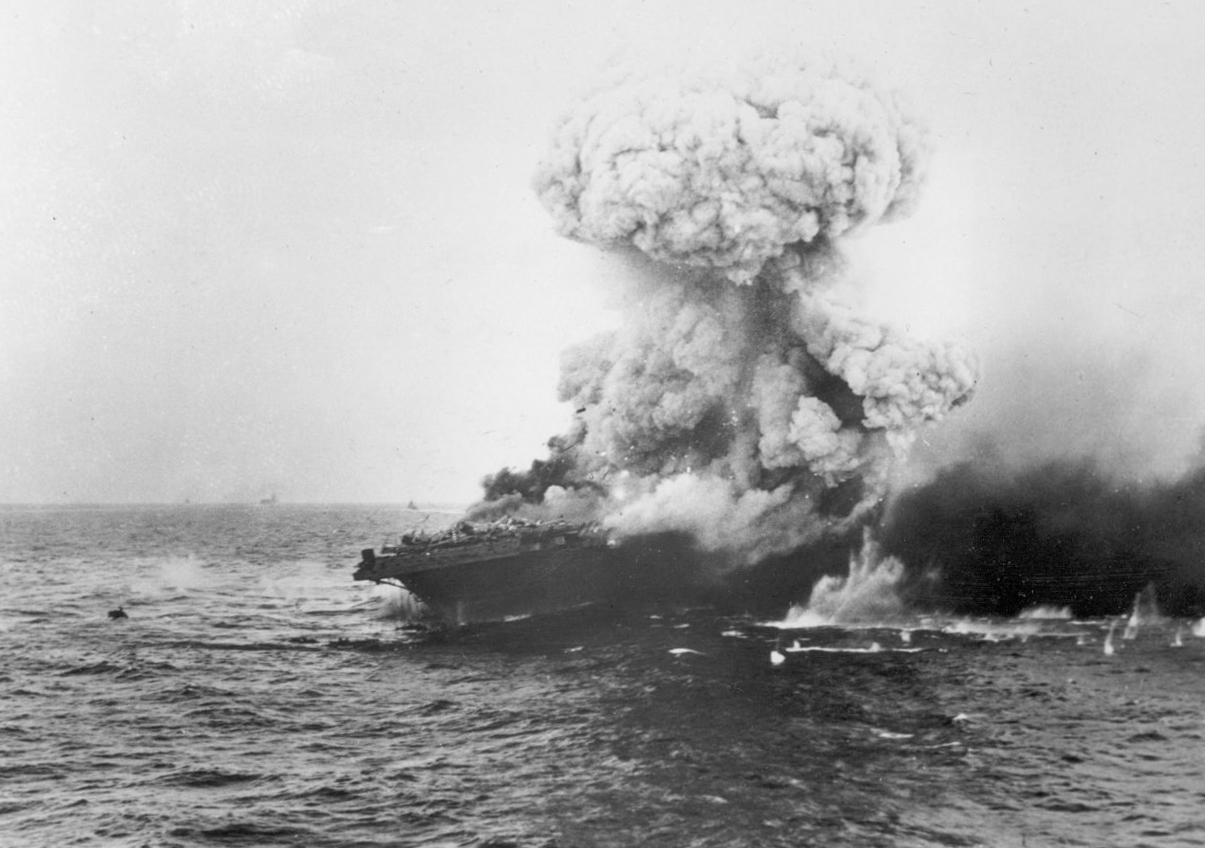
The American aircraft carrier USS Lexington explodes on 8
May 1942, several hours after being damaged by a Japanese carrier air attack.


Place your comment