


June 14, 1777: During the American Revolution, the
Continental Congress adopted a resolution stating
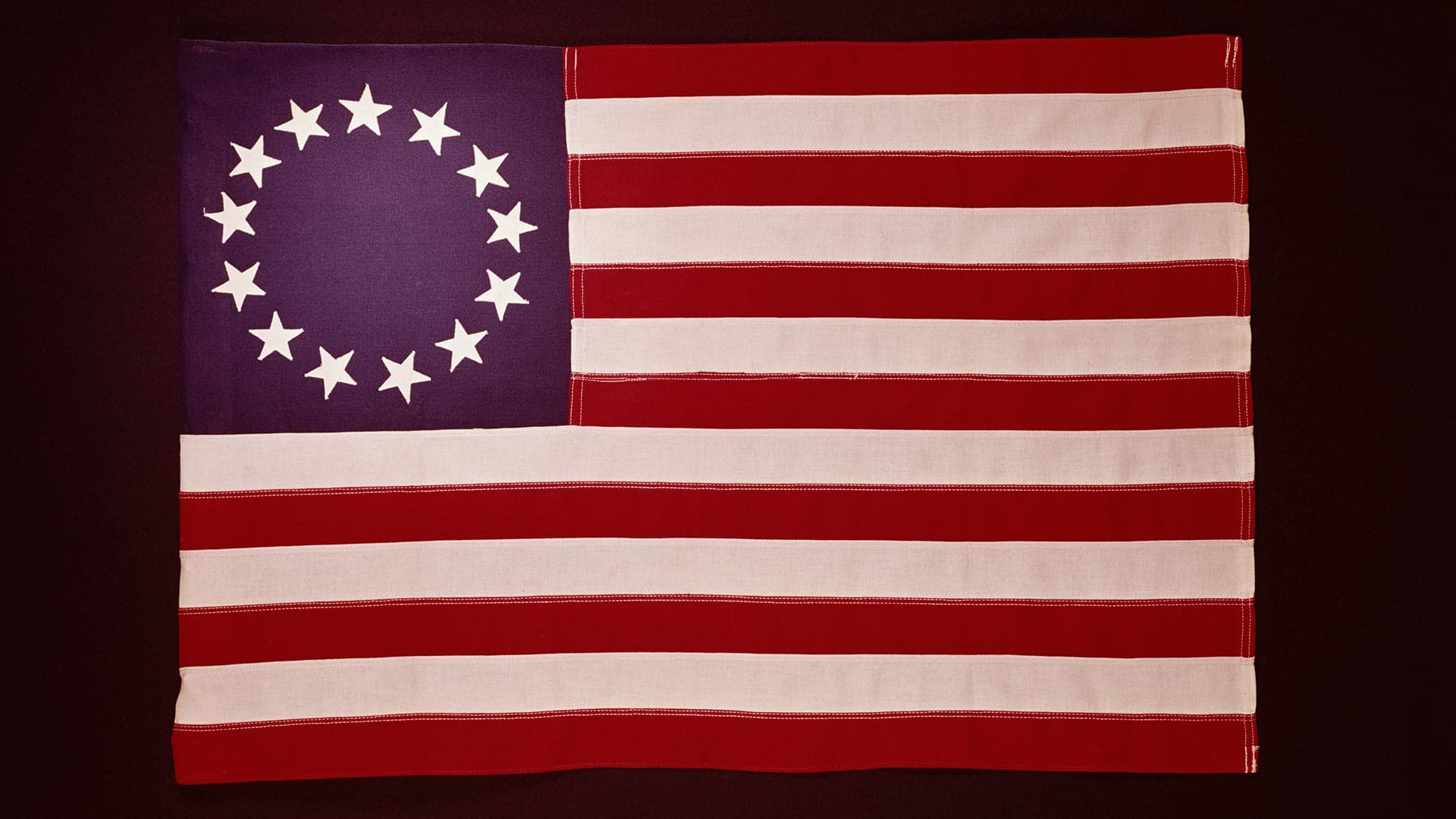
that “the flag of the United States be thirteen alternate
stripes red and white” and that “the Union be thirteen
stars, white in a blue field, representing a new Constellation.”
The national flag, which became known as the “Stars and Stripes,
” was based on the “Grand Union” flag, a banner carried by the Continental Army in 1776 that also consisted of 13 red and white
stripes. According to legend, Philadelphia seamstress Betsy
Ross designed the new canton for the Stars and Stripes, which
consisted of a circle of 13 stars and a blue background, at the
request of General George Washington. Historians have been
unable to conclusively prove or disprove this legend.
With the entrance of new states into the United States after independence, new stripes and stars were added to represent
new additions to the Union. In 1818, however, Congress enacted
a law stipulating that the 13 original stripes be restored and that
only stars be added to represent new states.



Elizabeth Griscom Ross
(January 1, 1752 – January 30, 1836)
June 14, 1777: During the American Revolution, the
Continental Congress adopted a resolution stating
“the flag of the United States be thirteen alternate
stripes red and white” and that “the Union be thirteen
stars, white in a blue field, representing a new
Constellation.”
The national flag, which became known as the “Stars
and Stripes,” was based on the “Grand Union” flag,
a banner carried by the Continental Army in 1776 that
also consisted of 13 red and white stripes.
According to legend, Philadelphia seamstress Betsy
Ross designed the new canton for the Stars and
Stripes, which consisted of a circle of 13 stars and
a blue background, at the request of General George
Washington. Historians have been unable to prove
or disprove this legend.


In 1916, President Woodrow Wilson issued a presidential
proclamation that designated June 14 as Flag Day.
The United States Army also celebrates the U.S. Army
birthday on this date, as Congress adopted the American
continental army after reaching a consensus position on
June 14, 1775.

Flag Day commemorates the adoption of the flag of the
United States on June 14, 1777 by resolution of the
Second Continental Congress.

In the United States, Flag Day is celebrated on June 14,
it commemorates the adoption of the flag of the United
States on June 14, 1777, by resolution of the Second
Continental Congress.The Flag Resolution, passed on
June 14, 1777, stated: "Resolved, That the flag of the
thirteen United States be thirteen stripes, alternate red
and white; that the union be thirteen stars, white in a
blue field, representing a new constellation."
The United States Army also celebrates the U.S. Army
birthday on this date; Congress adopted "the American
continental army" after reaching a consensus position
in the Committee of the Whole on June 14, 1775.
In 1916, President Woodrow Wilson issued a proclamation
that officially established June 14 as Flag Day; on August
3, 1949, National Flag Day was established by an Act of
Congress.


Thomas Woodrow Wilson
(December 28, 1856 – February 3, 1924)


