General George Washington at Valley Forge.

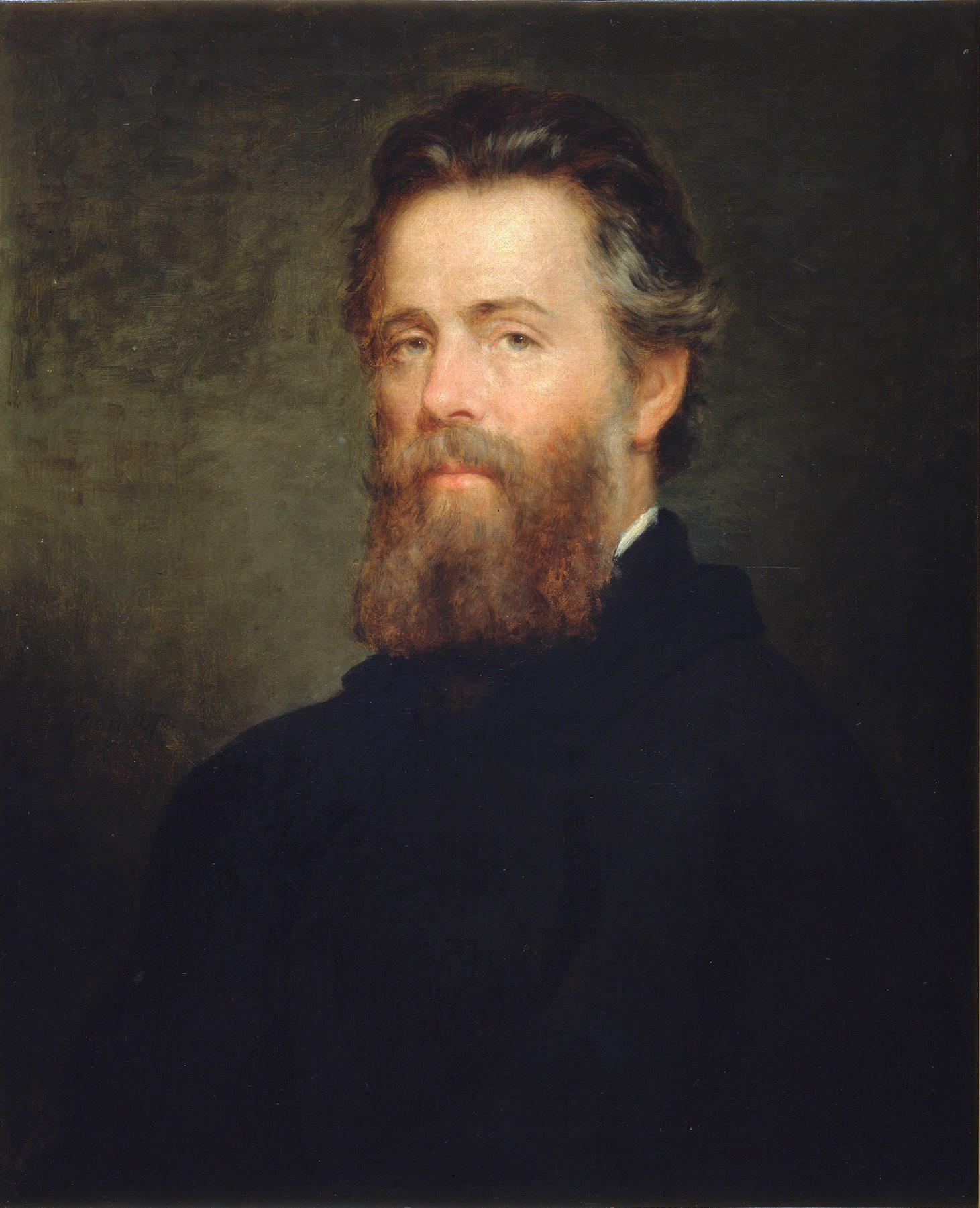
Herman Melville (born Melvill) (August 1, 1819 – September 28, 1891)
A towering figure in American literature, Herman Melville is the author of
several seafaring tales, including "Billy Budd, Sailor," "Typee," and "Moby
-Dick." He is also famous for shorter works such as "Bartleby, the Scrivener"
and "Benito Cereno."
Before fame, Melville worked as a surveyor for the Erie Canal before taking
a position on the crew of a New York ship headed for Liverpool. Later, he
sailed on the whaling ship Acushnet, an experience that inspired his
masterpiece novel, Moby-Dick.
A first edition copy of “Dracula” signed by Bram Stoker.
The first copies of the classic vampire novel Dracula, by Irish writer Bram
Stoker, appeared in London bookshops.
A childhood invalid, Stoker grew up to become a football (soccer) star at
Trinity College, Dublin. After graduation, he got a job in civil service at
Dublin Castle, where he worked for the next 10 years while writing drama
reviews for the Dublin Mail on the side. In this way, Stoker met the well-
respected actor Sir Henry Irving, who hired him as his manager. Stoker
stayed in the post for most of the next three decades, writing Irving’s
voluminous correspondence for him and accompanying him on tours
in the United States. Over the years, Stoker began writing a number of
horror stories for magazines, and in 1890 he published his first novel,
The Snake’s Pass. Stoker would go on to publish 17 novels in all
Abraham "Bram" Stoker
(November 8, 1847 – April 20, 1912)

Moby-Dick is now considered a great classic of American literature and
contains one of the most famous opening lines in fiction: “Call me Ishmael.” Initially, though, the book about Captain Ahab and his quest to catch a giant
white whale was a flop.
Its author, Herman Melville was born in New York City in 1819. As a young
man, he spent time in the merchant marines, the U.S. Navy and on a whaling
ship in the South Seas. In 1846, he published his first novel, Typee, a
romantic adventure based on his experiences in Polynesia. The book was
a success and a sequel, Omoo, was published in 1847. Three more novels
followed, with mixed critical and commercial results.
Herman Melville (Melvill) (August 1, 1819 – September 28, 1891)

George Orson Welles (May 6, 1915 – October 10, 1985)
“The War of the Worlds”—Orson Welles’s realistic radio dramatization of a
Martian invasion of Earth—is broadcast on the radio on October 30, 1938.
Welles was only 23 years old when his Mercury Theater company decided
to update H.G. Wells’ 19th-century science fiction novel The War of the
Worlds for national radio. Despite his age, Welles had been in radio for
several years, most notably as the voice of “The Shadow” in the hit
mystery program of the same name. “War of the Worlds” was not planned
as a radio hoax, and Welles had little idea of the havoc it would cause.
The show began on Sunday, October 30, at 8 p.m. A voice announced:
“The Columbia Broadcasting System and its affiliated stations present
Orson Welles and the Mercury Theater on the air in ‘War of the Worlds’
by H.G. Wells.”
Sunday evening in 1938 was prime-time in the golden age of radio, and
millions of Americans had their radios turned on. But most of these
Americans were listening to ventriloquist Edgar Bergen and his dummy
“Charlie McCarthy” on NBC and only turned to CBS at 8:12 p.m. after the
comedy sketch ended and a little-known singer went on. By then, the
story of the Martian invasion was well underway.