Archive for the 'SPACE' Category

FIRST AMERICAN IN SPACE ON THIS DAY IN 1961

Alan Shepard Becomes First American in Space — Mystic Stamp Discovery ...

On May 5, 1961, Navy Commander Alan Bartlett Shepard Jr. 
was launched into space aboard the Freedom 7 space
capsule, becoming the first American astronaut to travel
into space. The suborbital flight, which lasted 15 minutes
and reached a height of 116 miles into the atmosphere,
was a major triumph for the National Aeronautics and
Space Administration (NASA).

THIS DAY IN HISTORY – Alan Shepard becomes the first American in space ...

Alan Shepard is the first American in space.... - RareNewspapers.com

Freedom 7 Mercury capsule leaving Naval Academy for JFK Library, Smithsonian | collectSPACE

posted by Bob Karm in ANNIVERSARY,Astronaut,DEBUT,HISTORY,NASA,NEWSPAPER,Postage stamps,SPACE and have No Comments

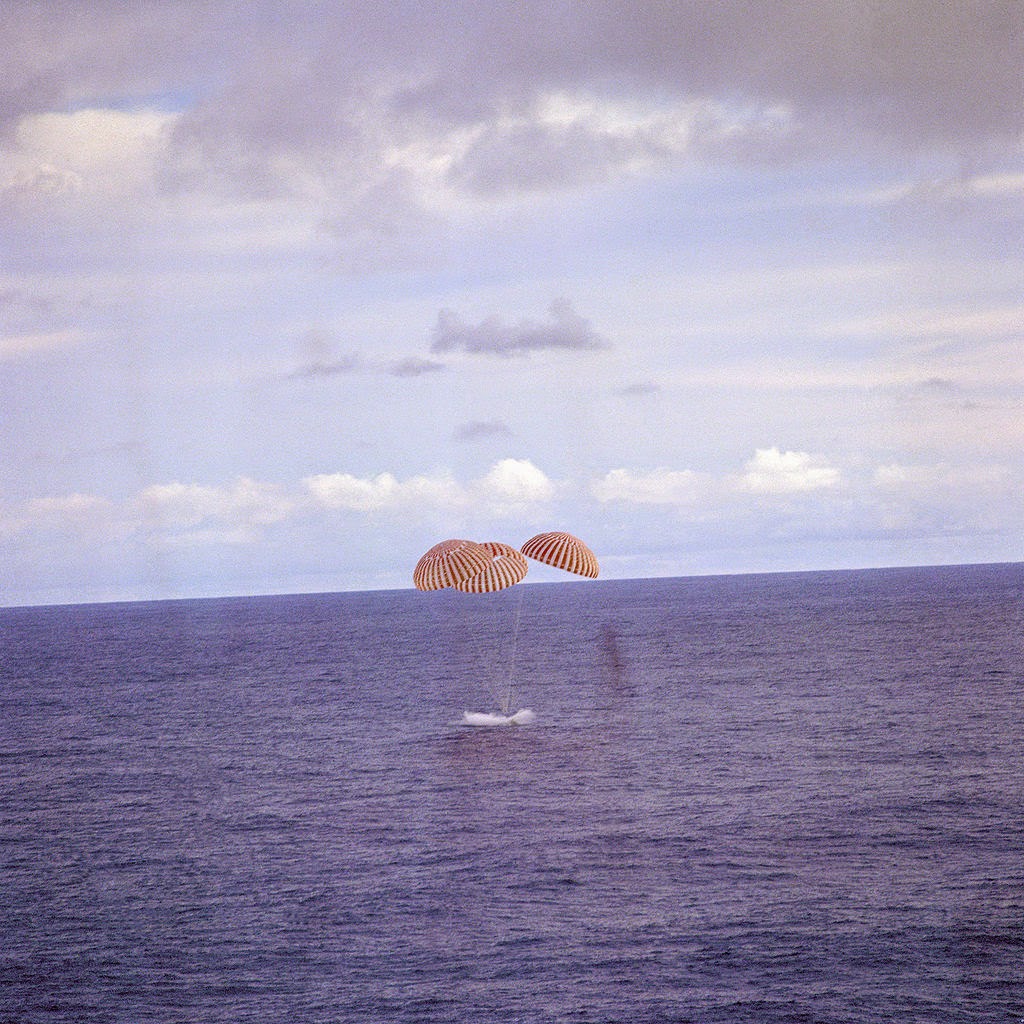
APOLLO CREW’S SAFE RETURN ON THIS DAY

Today in History: APRIL 17 = Apollo 13 Returns to Earth

50 Years Ago: Apollo 13 Crew Returns Safely to Earth | NASA
The crew, which included Fred Haise( left), Jim Lovell
(middle) and Jack Swigert (right).

With the world anxiously watching, Apollo 13, a U.S. lunar
spacecraft that suffered a
severe malfunction on its journey
to the moon, safely returned to Earth on April 17, 1970.

On April 11, the third manned lunar landing mission was
launched from Florida, carrying astronauts James A. Lovell,
John L. Swigert and Fred W. Haise. The mission was headed
for a landing on the Fra Mauro highlands of the moon.

However, two days into the mission, disaster struck 200,000
miles from Earth when oxygen tank No. 2 blew up in the
spacecraft. Swigert reported to mission control on Earth,
“Houston, we’ve had a problem here,” and it was discovered
that the normal supply of oxygen, electricity, light and water
had been disrupted.

The landing mission was aborted, and the astronauts and
controllers on Earth scrambled to come up with emergency
procedures. The crippled spacecraft continued to the moon,
looped around it, and began a long, cold journey back to Earth.

How the Apollo 13 Crew were saved by the Omega Speedmaster | Watches | Xupes

Apollo 13 - NASA Apollo 13 Launch Photos: This Day In History

Apollo 13 was set to be NASA¿s third mission to the moon, however, the crew had to abandon their plans two days after launch ¿ but not before they captured a stunning view of the lunar surface

The two-minute clip opens in darkness to honor the crew that were in pitch black for eight minutes while sitting between earthset and sunrise. The sun then appears from around the corner, revealing the lunar surface's majestic craters and pot marks

In the video, NASA takes viewers around parts of the moon for over a minute as music plays in the background ¿ and then the Earth appears

posted by Bob Karm in ANNIVERSARY,Astronauts,HISTORY,NASA,SPACE,Splasdown and have No Comments

SECOND MANNED MOON MISSION IN 1969

See the source image

Apollo 12, the second manned mission to the surface of the
moon, was launched from Cape Canaveral,
Florida, with
astronauts Charles Conrad, Jr.; Richard F. Gordon, Jr.; and
Alan L. Bean aboard. President
Richard Nixon viewed the
liftoff from Pad A at Cape Canaveral, the first president to 
attend the liftoff of a manned space flight.

Thirty-six seconds after takeoff, lightning struck the ascending
Saturn 5 launch rocket, which tripped the circuit breakers in the command module and caused a power failure. Fortunately, the
launching rocket continued up normally, and within a few
minutes power was restored in the spacecraft.

Picture 1 of 1

See the source image
December 12, 1969

posted by Bob Karm in ANNIVERSARY,Astronauts,HISTORY,NASA,SPACE and have No Comments

SATELLITE LAUNCHED ON THIS DAY IN 1957

See the source image

The Soviet Union inaugurated the “Space Age” with its launch
of Sputnik, the world’s first artificial satellite, on October 4, 1957.

The spacecraft, named Sputnik after the Russian word for “fellow traveler,” was launched at 10:29 p.m. Moscow time from the
Tyuratam launch base in the Kazakh Republic.

Sputnik had a diameter of 22 inches and weighed 184 pounds and
circled Earth once every hour and 36 minutes. Traveling at 18,000
miles an hour, its elliptical orbit had an apogee (farthest point from
Earth) of 584 miles and a perigee (nearest point) of 143 miles.

Visible with binoculars before sunrise or after sunset, Sputnik transmitted radio signals back to Earth strong enough to be
picked up by amateur radio operators. Those in the United
States with access to such equipment tuned in and listened
in awe as the beeping Soviet spacecraft passed over America
several times a day.

In January 1958, Sputnik’s orbit deteriorated, as expected, and
the spacecraft burned up in the atmosphere.

Soviet technician working on sputnik 1, 1957.
A Soviet technician works on Sputnik in 1957.

posted by Bob Karm in ANNIVERSARY,HISTORY,Satellite,Soviet Union,SPACE and have No Comments

PLANET OUTSIDE OUR SOLAR SYSTEM SEEN

See the source image

(Fox News) – NASA on Thursday shared an image taken by the
James Webb Telescope showing the first-ever direct image of
a planet outside our
solar system. 

NASA says the exoplanet, HIP 65426 b, is a gas giant, meaning
it has no rocky surface and could not be habitable. The image
can be seen through different bands of infrared light.

Sasha Hinkley, associate professor of physics and astronomy
at the University of Exeter in the United Kingdom, who led the observations, called the images a "transformative moment, not
only for Webb but also for astronomy generally."
 

See the source image

JWST spacecraft model 3.png
The James Webb Space Telescope.


The James Webb Space Telescope was launched on 25 December
2021 on an
Ariane 5 rocket from Kourou, French Guiana, and
arrived at the Sun–Earth
L2 Lagrange point in January 2022.

The telescope is the successor of the Hubble as NASA’s flagship
mission
in astrophysics.

posted by Bob Karm in Astronomy,CURRENT EVENTS,HISTORY,NASA,Photography,Planet,SPACE,Telescope and have No Comments