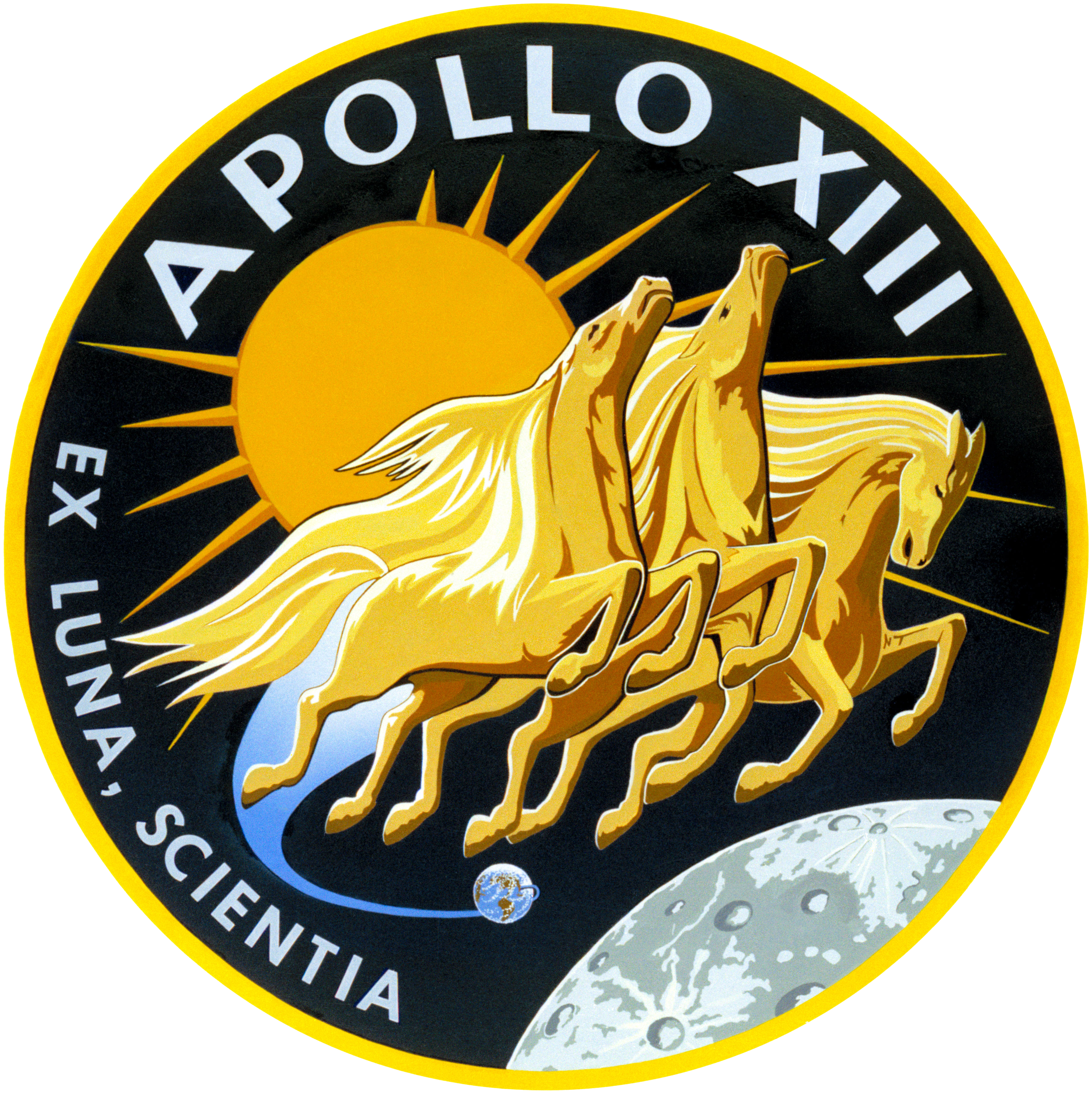
On April 11, 1970, Apollo 13, the third lunar landing mission, was successfully launched from Cape Canaveral, Florida, carrying astronauts James A. Lovell, John L. Swigert and Fred W. Haise.
The spacecraft’s destination was the Fra Mauro highlands of the moon, where the astronauts were to explore the Imbrium Basin and conduct geological experiments.
After an oxygen tank exploded on the evening of April 13, however, the new mission objective became to get the Apollo 13 crew home alive.
Walter M. Schirra, left, Alan B. Shepard, Virgil I. “Gus” Grissom, Donald K. “Deke” Slayton, John H. Glenn, M. Scott Carpenter, and L. Gordon Cooper.
On April 9, 1959, the National Aeronautics and Space Administration (NASA) formally introduced America’s first astronauts to the press: Scott Carpenter, L. Gordon Cooper Jr., John H. Glenn Jr., Virgil “Gus” Grissom, Walter Schirra Jr., Alan Shepard Jr. and Donald Slayton.
The seven men, all military test pilots, were carefully selected from a group of 32 candidates to take part in Project Mercury, America’s first manned space program.
NASA planned to begin manned orbital flights in 1961.
Apollo 14, piloted by astronauts Alan B. Shepard Jr., Edgar D. Mitchell and Stuart A. Roosa,was successfully launched from Cape Canaveral, Florida, on a manned mission to the moon.
On February 5, after suffering some initial problems in docking the lunar and command modules, Shepard and Mitchell were able to descend to the lunar surface on the third U.S. moon landing.
Upon stepping out of the lunar module, Shepard, who in 1961, aboard Freedom 7, was the first American in space, became the fifth astronaut to walk on the moon.
Shepard and Mitchell remained on the lunar surface for nearly 34 hours, conducting simple scientific experiments, such as hitting golf balls into space with Shepard’s golf club, and collecting 96 pounds of lunar samples. On February 9, Apollo 14 safely returned to Earth.
The crew of Apollo 14 in their spacesuits: Edgar D. Mitchel, Alan B. Shepard and Stuart A. Roosa.
Before and after shuttle explosion (first visible signs of danger on left, just after explosion on right).
At 11:38 a.m. EST, on January 28, 1986, the space shuttle Challenger lifted off from Cape Canaveral, Florida, and Christa McAuliffe is on her way to becoming the first ordinary U.S. civilian to travel into space.
McAuliffe, a 37-year-old high school social studies teacher from New Hampshire, won a competition that earned her a place among the seven-member crew of the Challenger.
She underwent months of shuttle training but then, beginning January 23, was forced to wait six long days as the Challenger‘s launch countdown was repeatedly delayed because of weather and technical problems. Finally, on January 28, the shuttle lifted off.
Seventy-three seconds later, hundreds on the ground, including Christa’s family, stared in disbelief as the shuttle broke up in a forking plume of smoke and fire.
Millions more watched the wrenching tragedy unfold on live television. There were no survivors.
The Final Crew of the Space Shuttle Challenger.
President Ronald Reagan addressing the nation from the White House on the day of the space shuttle Challenger explosion.
Recent photos taken by India’s Space Research Organization moon orbiter, known as Chandrayaan 2, clearly show the Apollo 11 and Apollo 12 landing sites more than 50 years later. (India Space Research Organization)
Astronauts first walked on the moon in July 1969 and again on the November 1969 Apollo 12 mission. (FOX NEWS)
The Chandrayaan-2 orbiter (above) was equipped with eight instruments to study the moon, including a lunar terrain mapping camera and a sensor to study the moon’s thin exosphere.