Archive for the 'MILITARY' Category

THE KENT STATE SHOOTINGS ON THIS DAY

How LIFE Magazine Covered the Kent State Shootings in 1970

50 years ago, the Kent State shootings sparked student unrest across America

The long shadow of May 4, 1970 (opinion)

On May 4, 1970, in Kent, Ohio, 28 National Guardsmen fire their
weapons at a group of anti-war demonstrators on the
Kent State University campus, killing four students and wounding nine.

The tragedy was a watershed moment for a nation divided by the
conflict in Vietnam, and further galvanized the
anti-war movement.

Two days earlier, on May 2, National Guard troops were called to
Kent to suppress students rioting in protest of the
Vietnam War
and the
U.S. invasion of Cambodia.

The next day, scattered protests were dispersed by tear gas,
and on May 4 class resumed at Kent State University.   

By noon that day, despite a ban on rallies, some 2,000 people
had assembled on the campus. National Guard troops arrived
and ordered the crowd to disperse, fired tear gas, and advanced
against the students with bayonets fixed on their rifles.

Some of the protesters, refusing to yield, responded by throwing
rocks and verbally taunting the
troops (below).


 Looking back at May 4, 1970: National Guard shootings at Kent State       
       
Kent State massacre: The shootings on a college campus 50 years ago changed  the country

The Kent State University shooting, 50 years later - Ohio History Connection

My God! They're Killing Us': Newsweek's 1970 Coverage of the Kent State  Shooting - Newsweek

posted by Bob Karm in ANNIVERSARY,DEATH,HISTORY,MAGAZINES,MILITARY,Shooting and have No Comments

FIRST NAVAL BATTLE BEGAN ON THIS DAY

Battle of the Coral Sea Begins | Mystic Stamp Discovery Center

Changing the Game: 80th Anniversary of the Battle of the Coral Sea > 514th  Air Mobility Wing > Display

On May 3, 1942, during World War II, the first modern naval
engagement in history, the
Battle of the Coral Sea, began. A
Japanese invasion force succeeds in occupying Tulagi of the
Solomon Islands in an expansion of Japan’s defensive perimeter.

The United States, having broken Japan’s secret war code and forewarned of an impending invasion of Tulagi and Port Moresby,
attempted to intercept the Japanese armada.

Four days of battles between Japanese and American aircraft
carriers resulted in 70 Japanese and 66 American warplanes
destroyed.

This confrontation, called the Battle of the Coral Sea, marked the
first air-naval battle in history, as none of the carriers fired at each
other, allowing the planes taking off from their decks to do the
battling.

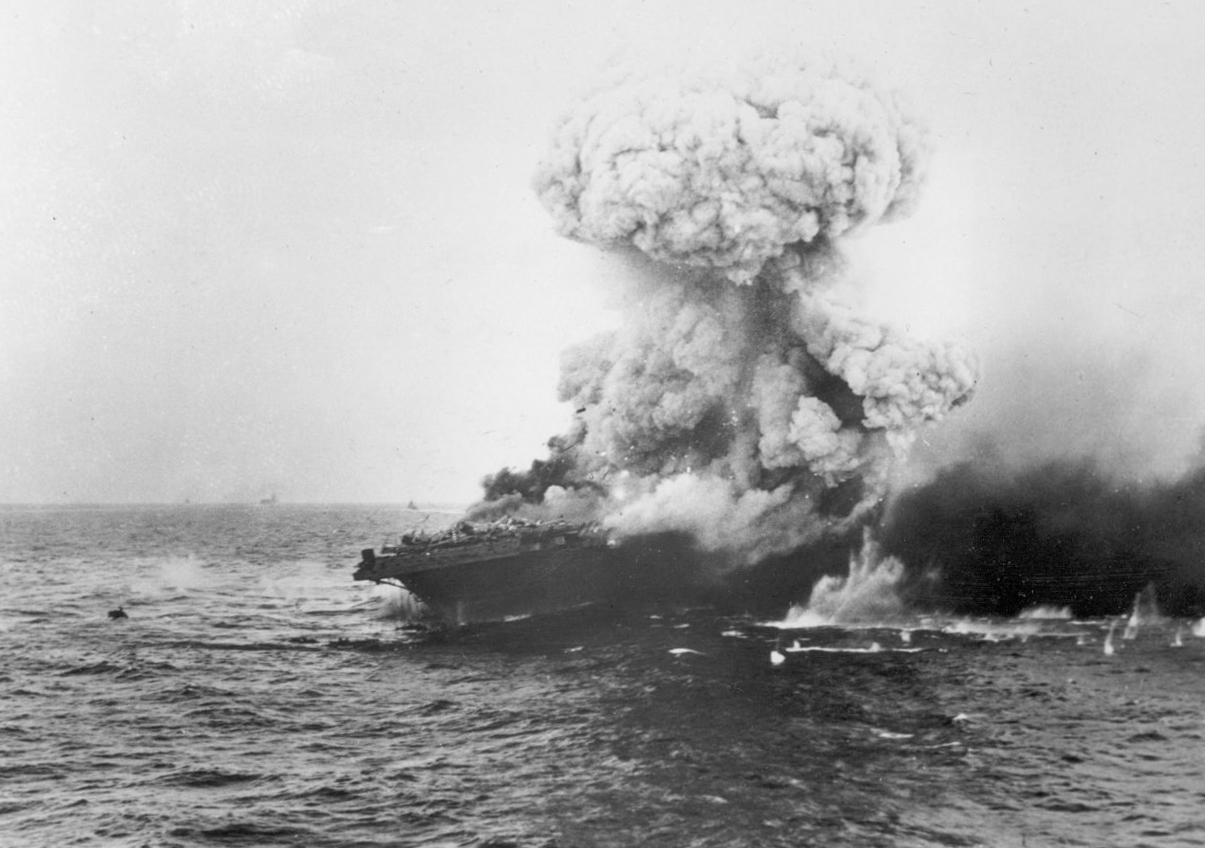
Among the casualties was the American carrier Lexington; “the
Blue Ghost” (so-called because it was not camouflaged like other carriers) suffered extensive aerial damage and was scuttled by
destroyer torpedoes. Two hundred sixteen Lexington crewmen
died as a result of the Japanese aerial bombardment.

Watch the WW2 Battle of the Coral Sea - In Color | War History Online

undefined
The American aircraft carrier USS Lexington explodes on 8
May 1942, several hours after being damaged by a Japanese carrier air attack.

                              1942: Battle of Coral Sea began. : Cryptologic Dates in History Calendar

posted by Bob Karm in Battle,HISTORY,MILITARY,Navy and have No Comments

THE 911 TERRORIST MASTERMIND KILLED

Osama bin Laden's death – how the US papers reacted, in pictures | World  news | The Guardian

Osama bin Laden, the mastermind behind the September 11,
2001, terrorist attacks
in the United States, was killed by U.S.
forces
during a raid on his compound hideout in Pakistan.

The notorious, 54-year-old leader of Al Qaeda, the terrorist
network of Islamic extremists, had been the target of a nearly
decade-long international manhunt.

The raid began around 1 a.m. local time (4 p.m. EST on May 1,
2011 in the United States), when 23 U.S. Navy SEALs in two
Black Hawk helicopters descended on the compound in
Abbottabad, a tourist and military center north of Pakistan’s
capital, Islamabad. One of the helicopters crash-landed into
the compound but no one aboard was hurt.

During the raid, which lasted approximately 40 minutes, five
people, including bin Laden and one of his adult sons, were
killed by U.S. gunfire. No Americans were injured in the assault.

May 1, 2011: President Obama Announces Bin Laden's Death

Seven Questions After the Death of bin Laden | Council on Foreign Relations
A vendor walks past a sand sculpture of al-Qaeda leader
Osama bin Laden created by Indian sand artist Sudarshan Patnaik on a beach in Puri in the eastern Indian state of
Orissa on May 2, 2011.
(Reuters)

posted by Bob Karm in 911,ANNIVERSARY,HISTORY,Killed,MILITARY,NEWSPAPER,President,Terrirust attack and have No Comments

CIVIL WAR LEADER BORN ON THIS DAY

Ulysses S. Grant in St. Louis 1854-1860 (U.S. National Park Service)

General Ulysses S. Grant, between 1860 and 1870 : r/ColorizedHistory

Ulysses S. Grant - People at The Fort - Fort Vancouver - Pacific NW History  and Historical Sites
Ulysses S. Grant (April 27, 1822 – July 23, 1885)

Ulysses S. Grant, Civil War leader and 18th president of the
United States, was born on April 27, 1822, in Point Pleasant,
Ohio.

The son of a tanner, Grant showed little enthusiasm for joining
his father’s business, so the elder Grant enrolled his son at
West Point in 1839.

Though Grant later admitted he had no interest in the military
apart from honing his equestrian skills, he graduated in 1843
and went on to serve in the
Mexican-American War, though
he opposed it on moral grounds. He then left his beloved wife
and children again to fulfill a tour of duty in California and
Oregon.

Bookmark] Discovering the Promise of Asia and America in Grant's Visit to  Japan | JAPAN Forward

posted by Bob Karm in BIRTHDAY,Civil war,Currency,HISTORY,MILITARY,President and have No Comments

A RESCUE MISSION ENDED IN DISASTER

Jimmy Carter: What was the Iranian hostage crisis? – WPXI

The Iran Hostage Crisis and US President Jimmy Carter

On April 24, 1980, an ill-fated military operation to rescue
the 52 American hostages held in Tehran ended with eight
U.S. servicemen dead and no hostages rescued.

With the Iran Hostage Crisis stretching into its sixth month
and all diplomatic appeals to the Iranian government ending
in failure, President
Jimmy Carter ordered the military mission
as a last ditch attempt to save the hostages.

During the operation, three of eight helicopters failed, crippling
the crucial airborne plans. The mission was then canceled at
the staging area in Iran, but during the withdrawal one of the
retreating helicopters collided with one of six C-130 transport
planes, killing eight service members and injuring five.

The next day, a somber Jimmy Carter gave a press conference
in which he took full responsibility for the tragedy. The hostages
were not released for another 270 days
.

President Carter flew to West Germany to greet the Americans
on their way home.

The Failed Iran Hostage Rescue, 1980 - by Brenda Elthon

Chronicle Covers: The deadly peak of the Iran hostage crisis

Iran hostage crisis to be focus of upcoming talk | Lifestyles |  transylvaniatimes.com

1980 Hostage rescue mission ends in disaster – Bowie News

posted by Bob Karm in ANNIVERSARY,Aviation,HISTORY,Hostage crisis,MILITARY,NEWSPAPER,President and have No Comments