CAMILLE BOHANNON


On March 7, 1876, 29-year-old Alexander Graham Bell received a
patent for his revolutionary new invention: the telephone.
The Scottish-born Bell worked in London with his father, Melville
Bell, who developed Visible Speech, a written system used to
teach speaking to the deaf. In the 1870s, the Bells moved to
Boston, Massachusetts, where the younger Bell found work as
a teacher at the Pemberton Avenue School for the Deaf. He later
married one of his students, Mabel Hubbard.
While in Boston, Bell became very interested in the possibility of transmitting speech over wires. Samuel F.B. Morse’s invention
of the telegraph in 1843 had made nearly instantaneous
communication possible between two distant points.
With the help of Thomas A. Watson, a Boston machine shop
employee, Bell developed a prototype.
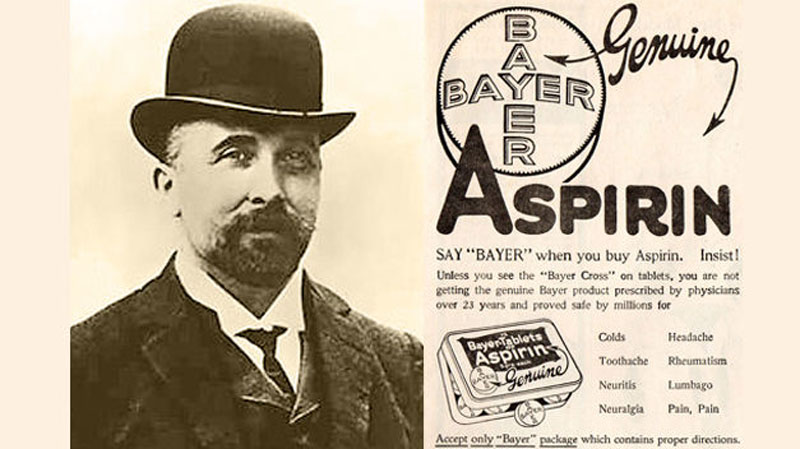
Felix Hoffmann
(21 January 1868 – 8 February 1946)
The German company Bayer patents aspirin on March 6, 1899.
Now the most common drug in household medicine cabinets, acetylsalicylic acid was originally made from a chemical found
in the bark of willow trees. In its primitive form, the active
ingredient, salicin, was used for centuries in folk medicine,
beginning in ancient Greece when Hippocrates used it to relieve
pain and fever. Known to doctors since the mid-19th century, it
was used sparingly due to its unpleasant taste and tendency to
damage the stomach.
In 1897, Bayer employee Felix Hoffmann found a way to create a
stable form of the drug that was easier and more pleasant to take.
(Some evidence shows that Hoffmann’s work was really done by
a Jewish chemist, Arthur Eichengrun, whose contributions were
covered up during the Nazi era.)


Jacob Davis (left) and Levi Strauss (right)
San Francisco businessman Levi Strauss and Reno, Nevada,
tailor Jacob Davis were given a patent to create work pants reinforced
with metal rivets, marking the birth of one of the world’s most
famous garments: blue jeans.


On May 20, 1873, San Francisco businessman Levi Strauss and
Reno, Nevada, tailor Jacob Davis (above) were given a patent to
create work pants reinforced with metal rivets, marking the birth
of one of the world’s most famous garments: blue jeans.
![]()