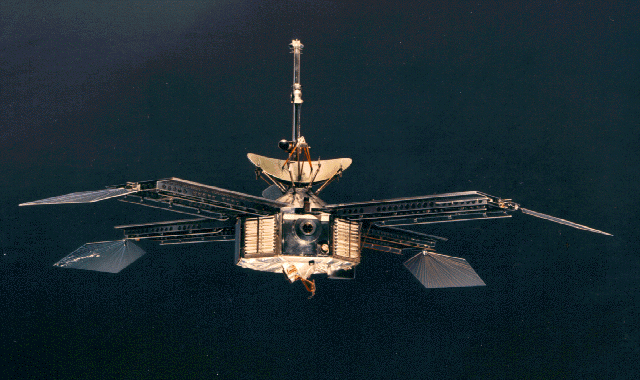
On this day in 1974, Mariner 10, the U.S. space probe became the first spacecraft to reach the planet Mercury. It had been launched on November 3, 1973.Mariner 10 was the first spacecraft to return high-resolution digital color images.
A photomosaic of Mercury images taken by Mariner 10, tinted to approximate the appearance of Mercury.
The Mount Vesuvius eruption killed approximately 20,000 people and much of the area was buried in volcanic ash.
It happened on this day in 1814.
On this day in 2006.
The planet Pluto was reclassified as a "dwarf planet" by the International Astronomical Union (IAU). Pluto’s status was changed due to the IAU’s new rules for an object qualifying as a planet. Pluto met two of the three rules because it orbits the sun and is large enough to assume a nearly round shape. However, since Pluto has an oblong orbit and overlaps the orbit of Neptune it disqualified Pluto as a planet.
On this day in 1932, Amelia Earhart became the first woman to fly across the U.S. non-stop. The trip from Los Angeles, CA to Newark, NJ, took about 19 hours in her Lockheed Vega (above).
Amelia Earhart’s Lockheed Model 5B Vega, NR7952, on display at the Smithsonian Institution National Air and Space Museum.
On this day in 1989, Pete Rose, the manager of the Cincinnati Reds, was banned from baseball for life after being accused of gambling on baseball.
Former Cincinnati Reds manager Pete Rose at the start of a news conference at Riverfront Stadium after being given his lifetimesuspension from baseball.
Mariner 4 (together with Mariner 3 known as Mariner–Mars 1964) was the fourth in a series of spacecraft intended for planetary exploration in a flyby mode. It was designed to conduct close up scientific observations of Mars and to transmit these observations to Earth. Mariner 4 performed the first successful flyby of the planet Mars, returning the first pictures of the Martian surface. On December 21, 1967 communications with Mariner 4 were terminated.