TIM MAGUIRE
TIM MAGUIRE

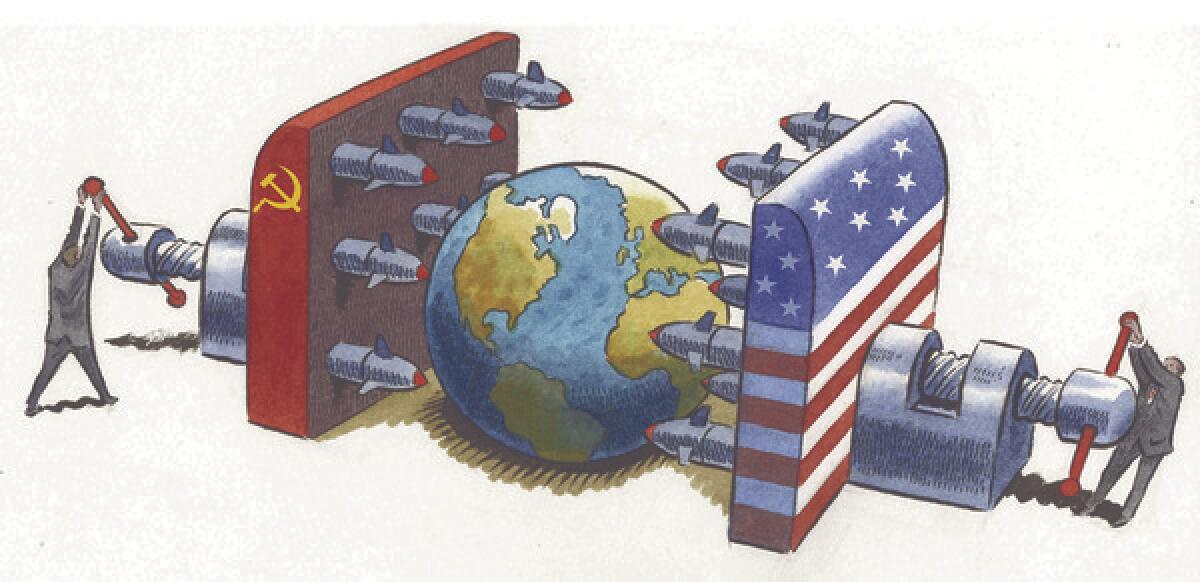
Complicated and tension-filled negotiations between the United
States and the Soviet Union finally result in a plan to end the two
-week-old Cuban Missile Crisis. A frightening period in which
nuclear holocaust seemed imminent began to come to an end.


On August 8, 1945, the Soviet Union officially declared war on
Japan, pouring more than 1 million Soviet soldiers the following
day into Japanese-occupied Manchuria, northeastern China, to
take on the 700,000-strong Japanese army.
Despite a strong Japanese army comprised of a million men
awaiting them, the Soviet force, under command of Marshal
Alexander Vasilevsky, swept into China, Korea and the Kuril
Islands, forcing a rapid retreat.
By the end of the engagement, the Soviets had only lost around
8,000 troops compared to the 80,000 lost by Japan.


On June 16, 1963, aboard Vostok 6, Soviet Cosmonaut Valentina Tereshkova became the first woman to travel into space. After
48 orbits and 71 hours, she returned to earth, having spent more
time in space than all U.S. astronauts combined to that date.
Valentina Vladimirovna Tereshkova was born to a peasant family
in Maslennikovo, Russia, in 1937. She began work at a textile
factory when she was 18, and at age 22 she made her first
parachute jump under the auspices of a local aviation club.
Her enthusiasm for skydiving brought her to the attention of the
Soviet space program, which sought to put a woman in space in
the early 1960s as a means of achieving another “space first”
before the United States.
![[object Object]](https://upload.wikimedia.org/wikipedia/commons/8/86/RIAN_archive_159271_Nikita_Khrushchev%2C_Valentina_Tereshkova%2C_Pavel_Popovich_and_Yury_Gagarin_at_Lenin_Mausoleum.jpg)
Tereshkova, and Nikita Khrushchev at Lenin’s Mausoleum
on 22 June 1963.

Tereshkova (87) in 2024.


TIM MAGUIRE