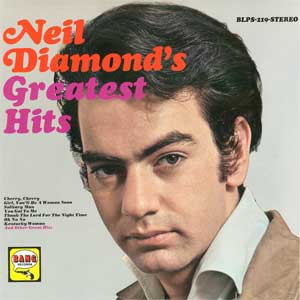
Neil Diamond is the Brooklyn-born singer-songwriter of "Sweet Caroline," "Coming to America" and "Cracklin’ Rosie.” He has
sold over 100 million records.
Neil Diamond is the Brooklyn-born singer-songwriter of "Sweet Caroline," "Coming to America" and "Cracklin’ Rosie.” He has
sold over 100 million records.


ROSS SIMPSON

The Blue Marble, by Apollo 17 (1972).
2025 was our planet Earth’s third-warmest year on record. That’s
just one notable fact taken from NOAA’s 2025 Global Climate
Analysis released earlier this week.
The report shows how each region of the world compares to the
past (in terms of temperature and precipitation), as well as how
and where severe weather had impacts during the 2025 year.
(Keep in mind that climate record-keeping began in 1850).
The world’s warmest year was 2024, and 2023 comes in second.
For the United States, we find that 2025 was our fourth-warmest
year. October specifically set a record as the warmest October
in the United States on record, while September and November
each ranked second-warmest.


On January 23, 1968, the USS Pueblo, a Navy intelligence
vessel, was engaged in a routine surveillance of the North
Korean coast when it was intercepted by North Korean
patrol boats.
According to U.S. reports, the Pueblo was in international
waters almost 16 miles from shore, but the North Koreans
turned their guns on the lightly armed vessel and demanded
its surrender.
The Americans attempted to escape, and the North Koreans
opened fire, wounding the commander and two others.
With capture inevitable, the Americans stalled for time,
destroying the classified information aboard while taking
further fire. Several more crew members were wounded.
These men were hailed as heroes and returned home to
the United States in time for Christmas.


Lloyd Mark "Pete" Bucher
(September 1, 1927 – January 28, 2004)

The USS Pueblo is now on display at a North Korean war
museum.


Elizabeth Blackwell (February 3, 1821 – May 31, 1910)
At a graduation ceremony in a church in Geneva, New York on
January 23, 1849, Geneva Medical College bestowed a medical
degree upon Elizabeth Blackwell, the first woman in the United
States to receive one.
Despite the near-uniform opposition of her fellow students and
medical professionals, Blackwell pursued her calling with an
iron will and dedicated her life to treating the sick and furthering
the cause of women in medicine.

Illustration of medical students attending a lecture at
the Woman’s Medical College of the New York Infirmary,
founded by Elizabeth and Emily Blackwell.


