
On January 29, 1936, the U.S. Baseball Hall of Fame elected its
first members in Cooperstown, New York: Ty Cobb, Babe Ruth,
Honus Wagner, Christy Matthewson and Walter Johnson.

On January 29, 1936, the U.S. Baseball Hall of Fame elected its
first members in Cooperstown, New York: Ty Cobb, Babe Ruth,
Honus Wagner, Christy Matthewson and Walter Johnson.


MIKE GREACIA

On January 7, 1999, the impeachment trial of President Bill
Clinton, formally charged with lying under oath and
obstructing justice, began in the Senate. As instructed
in Article 1 of the U.S. Constitution, Supreme Court Chief
Justice William Rehnquist was sworn in to preside (below),
and the senators were sworn in as jurors. Congress had only
attempted to remove a president on one other occasion:
the 1868 impeachment trial of President Andrew Johnson,
who incurred the Republican Party’s wrath after he proposed
a conservative Reconstruction plan.


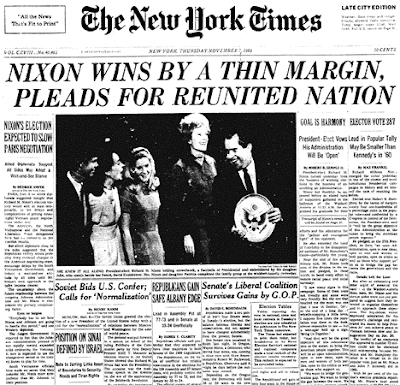
Winning one of the closest elections in U.S. history, Republican challenger Richard Nixon defeated Vice President Hubert
Humphrey November 5, 1968. Because of the strong showing
of third-party candidate George Wallace, neither Nixon nor
Humphrey received more than 50 percent of the popular vote;
Nixon beat Humphrey by less than 500,000 votes.
Nixon campaigned on a platform designed to reach the “silent
majority” of middle class and working class Americans. He
promised to “bring us together again,” and many Americans,
weary after years of antiwar and civil rights protests, were
happy to hear of peace returning to their streets. Foreign
policy was also a major factor in the election.

In one of the most crushing victories in the history of U.S.
presidential elections, incumbent Lyndon Baines Johnson
defeated Republican challenger Barry Goldwater, Sr.
With over 60 percent of the popular vote, Johnson turned
back the conservative senator from Arizona to secure his
first full term in office after succeeding to the presidency
after the assassination of John F. Kennedy in November
1963.
During the 1964 campaign, Goldwater was decidedly critical
of Johnson’s liberal domestic agenda, railing against welfare
programs and defending his own decision to vote against the
Civil Rights Act passed by Congress earlier that year.
However, some of the most dramatic differences between the
two candidates appeared over the issue of Cold War foreign
policy.
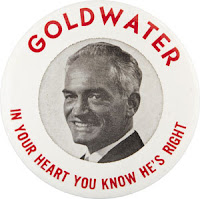

Topps 1964 Johnson VS. Goldwater 5-Cent Display Box.


