

On November 13, 1974, 28-year-old Karen Silkwood was killed
in a car accident near Crescent, Oklahoma, north of Oklahoma
City. Silkwood worked as a technician at a plutonium plant
operated by the Kerr-McGee Corporation, and she had been
critical of the plant’s health and safety procedures.
In September, she had complained to the Atomic Energy
Commission about unsafe conditions at the plant (a week
before her death, plant monitors had found that she was
contaminated with radioactivity herself), and the night she
died, she was on her way to a meeting with a union rep and
a reporter for The New York Times, reportedly with a folder full
of documents that proved that Kerr-McGee was acting negligently
when it came to worker safety at the plant. However, no such
folder was found in the wreckage of her car, lending credence to
the theory that someone had forced her off the road to prevent her
from telling what she knew.


The story was chronicled in Mike Nichols‘s 1983
Academy Award nominated film Silkwood in
which she was portrayed by Meryl Streep.

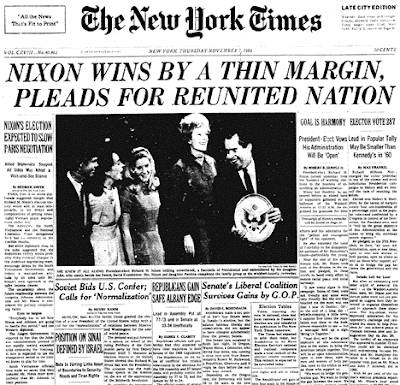
Winning one of the closest elections in U.S. history, Republican challenger Richard Nixon defeated Vice President Hubert
Humphrey November 5, 1968. Because of the strong showing
of third-party candidate George Wallace, neither Nixon nor
Humphrey received more than 50 percent of the popular vote;
Nixon beat Humphrey by less than 500,000 votes.
Nixon campaigned on a platform designed to reach the “silent
majority” of middle class and working class Americans. He
promised to “bring us together again,” and many Americans,
weary after years of antiwar and civil rights protests, were
happy to hear of peace returning to their streets. Foreign
policy was also a major factor in the election.

In one of the greatest upsets in presidential election history,
Democratic incumbent Harry S. Truman defeats his Republican challenger, Governor Thomas E. Dewey of New York, by just
over two million popular votes. In the days preceding the vote,
political analysts and polls were so behind Dewey that on
election night, long before all the votes were counted, the
Chicago Tribune published an early edition with the banner
headline “DEWEY DEFEATS TRUMAN (above).”

Rare Truman Defeats Dewey Newspaper.

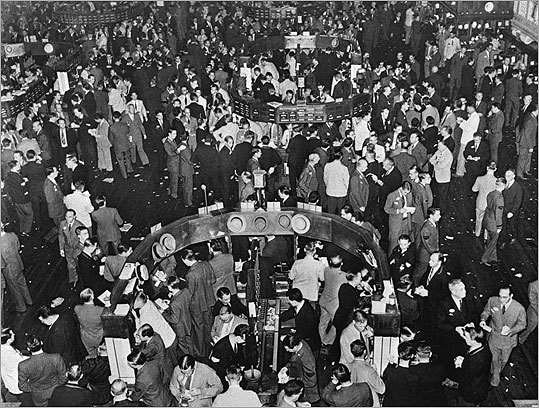
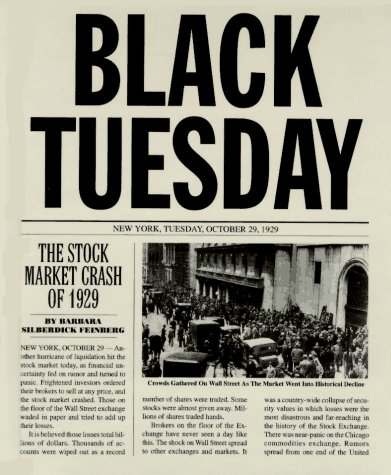
Black Tuesday hit Wall Street in 1929 as investors trade 16,410,030 shares on the New York Stock Exchange in a single day. Billions
of dollars were lost, wiping out thousands of investors, and stock
tickers ran hours behind because the machinery could not
handle the huge volume of trading. In the aftermath of Black
Tuesday, America and the rest of the industrialized world spiraled downward into the Great Depression.