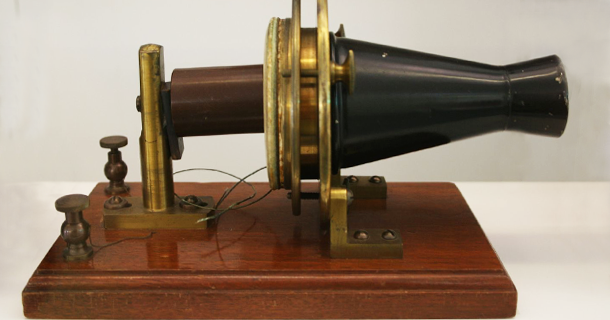
On March 7, 1876, 29-year-old Alexander Graham Bell received
a patent for his revolutionary new invention: the telephone.


On March 7, 1876, 29-year-old Alexander Graham Bell received
a patent for his revolutionary new invention: the telephone.


The German company Bayer patented aspirin on March 6,
1899. Now the most common drug in household medicine
cabinets, acetylsalicylic acid was originally made from a
chemical found in the bark of willow trees. In its primitive
form, the active ingredient, salicin, was used for centuries
in folk medicine, beginning in ancient Greece when
Hippocrates used it to relieve pain and fever. Known to
doctors since the mid-19th century, it was used sparingly
due to its unpleasant taste and tendency to damage the
stomach.
In 1897, Bayer employee Felix Hoffmann (above) found a
way to create a stable form of the drug that was easier and
more pleasant to take. (Some evidence shows that Hoffmann’s
work was really done by a Jewish chemist, Arthur Eichengrun,
whose contributions were covered up during the Nazi era.)
After obtaining the patent rights, Bayer began distributing
aspirin in powder form to physicians to give to their patients
one gram at a time. The brand name came from “a” for acetyl,
“spir” from the spirea plant (a source of salicin) and the suffix
“in,” commonly used for medications. It quickly became the
number-one drug worldwide.

Mary Elizabeth Anderson (February 19, 1866 – June 27, 1953)
The patent office awarded U.S. Patent No. 743,801 to a Birmingham, Alabama woman named Mary Anderson for her “window cleaning
device for electric cars and other vehicles to remove snow, ice or
sleet from the window.” When she received her patent, Anderson
tried to sell it to a Canadian manufacturing firm, but the company refused: The device had no practical value, it said, and so was not
worth any money. Though mechanical windshield wipers were
standard equipment in passenger cars by around 1913, Anderson
never profited from the invention.
Versatile, inexpensive and relatively easy to play, the acoustic
guitar was a staple of American rural music in the early 20th
century, particularly black rural music such as the blues. But
a significant physical limitation made it a poor fit in ensembles
made up of brass, woodwind and orchestral string instruments:
The acoustic guitar was simply too quiet.
What transformed the guitar and its place in popular music, and eventually transformed popular music itself, was the development
of a method for transforming the sound of a vibrating guitar string
into an electrical signal that could be amplified and re-converted
into audible sound at a much greater volume.
The electric guitar—the instrument that revolutionized jazz, blues
and country music and made the later rise of rock and roll possible,
was recognized by the United States Patent Office on August 10,
1937 with the award of Patent #2,089.171 to G.D. Beauchamp for an instrument known as the Rickenbacker Frying Pan.
Inventor G.D. Beauchamp, partner with Adolph Rickenbacher in the Electro String Instrument Corporation of Los Angeles, California,
spent more than five years pursuing his patent on the Frying Pan.