TIM MAGUIRE

TIM MAGUIRE


On January 7, 1999, the impeachment trial of President
Bill Clinton, formally charged with lying under oath and
obstructing justice, began in the Senate.
As instructed in Article 1 of the U.S. Constitution,
Supreme Court Chief Justice William Rehnquist was
sworn in to preside, and the senators were sworn in
as jurors.
Congress had only attempted to remove a president on
one other occasion: the 1868 impeachment trial of
President Andrew Johnson, who incurred the Republican
Party’s wrath after he had proposed a conservative
Reconstruction plan.

Chief Justice William Rehnquist (top left) swearing in senators.

February 12, 1999.


CAMILLE BOHANNON
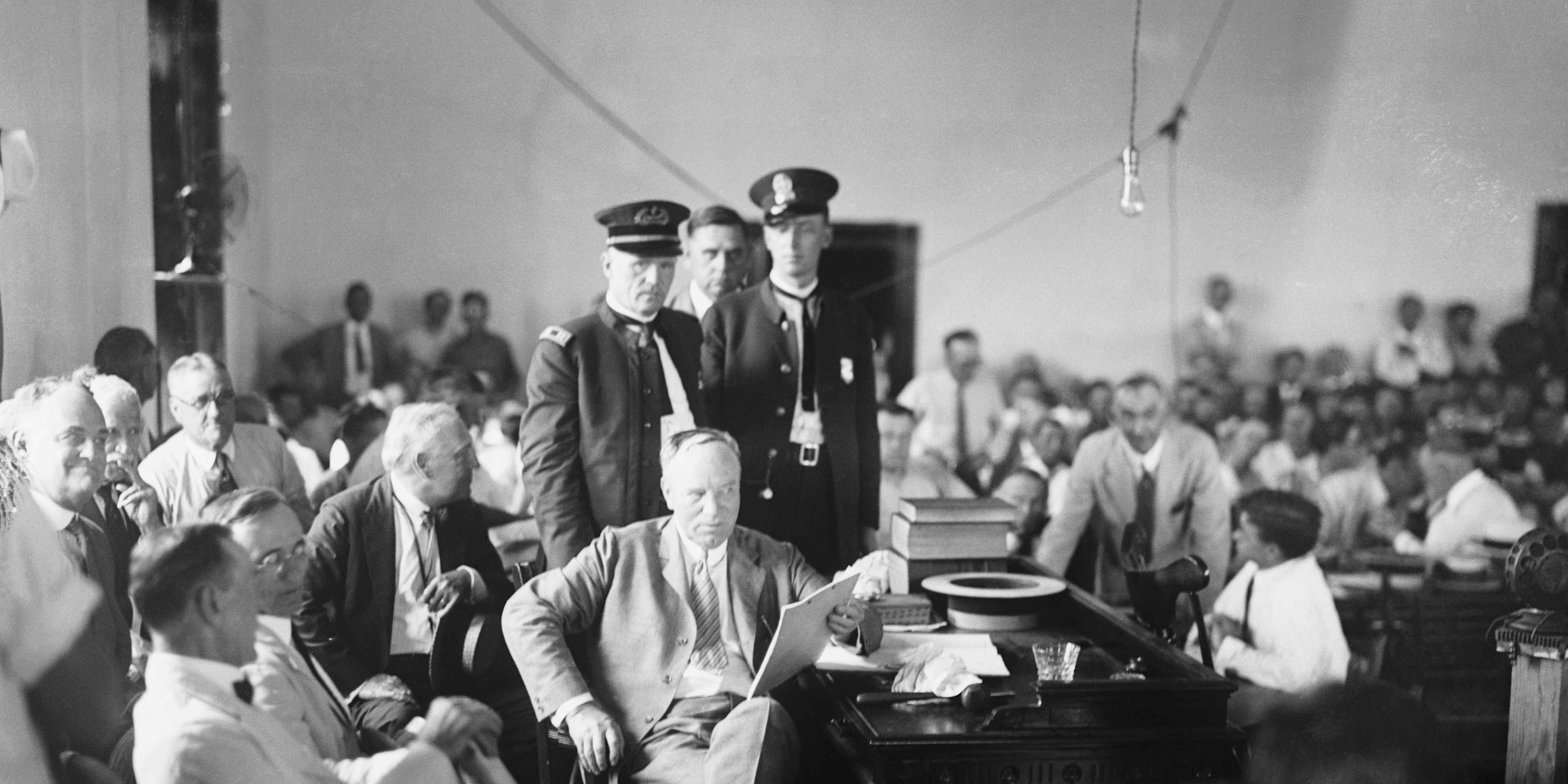
July 10, 1925: In Dayton, Tennessee, the so-called Scopes
Monkey Trial began with John Thomas Scopes, a young
high school science teacher, accused of teaching evolution
in violation of the Butler Act, a Tennessee state law.
The law, passed in March, made it a misdemeanor punishable
by fine to “teach any theory that denies the story of the Divine
Creation of man as taught in the Bible, and to teach instead
that man has descended from a lower order of animals.”
The trial became a national spectacle, with prominent figures
like Clarence Darrow defending Scopes and William Jennings
Bryan assisting the prosecution.

John Thomas Scopes(1900 – 1970) the teacher
on trial for teaching evolution.

Defense attorney Clarence Darrow, left, and
prosecutor William Jennings Bryan speak
with each other during the trial.


On April 26, 1954, the Salk polio vaccine field trials, involving
1.8 million children, began at the Franklin Sherman Elementary
School in McLean, Virginia.
Children in the United States, Canada and Finland participated
in the trials, which used for the first time the now-standard
double-blind method, whereby neither the patient nor attending
doctor knew if the inoculation was the vaccine or a placebo.
One year later, on April 12, 1955, researchers announced the
vaccine was safe and effective and it quickly became a standard
part of childhood immunizations in America.


Jonas Salk holding bottles of culture he
used to develop the polio vaccine.
Today, polio has been eliminated throughout
much of the world due to the vaccine; but,
there is still no cure for the disease and it
persists in a small number of countries in
Africa and Asia.