At 2:10 p.m., five U.S. Navy Avenger torpedo-bombers comprising
Flight 19 took off from the Ft. Lauderdale Naval Air Station in Florida
on a routine three-hour training mission. Flight 19 was scheduled to
take them due east for 120 miles, north for 73 miles, and then back
over a final 120-mile leg that would return them to the naval base.
They never returned.
Two hours after the flight began, the leader of the squadron, who
had been flying in the area for more than six months, reported that
his compass and back-up compass had failed and that his position
was unknown. The other planes experienced similar instrument malfunctions. Radio facilities on land were contacted to find the
location of the lost squadron, but none were successful. After two
more hours of confused messages from the fliers, a distorted radio transmission from the squadron leader was heard at 6:20 p.m., apparently calling for his men to prepare to ditch their aircraft simultaneously because of lack of fuel.


The United States Naval Academy opened in Annapolis, Maryland,
with 50 midshipmen students and seven professors. Known as the
Naval School until 1850, the curriculum included mathematics and navigation, gunnery and steam, chemistry, English, French along
with natural philosophy.
The Naval School officially became the U.S. Naval Academy in 1850,
and a new curriculum went into effect, requiring midshipmen to
study at the academy for four years and to train aboard ships each
summer—the basic format that remains at the academy to this day.


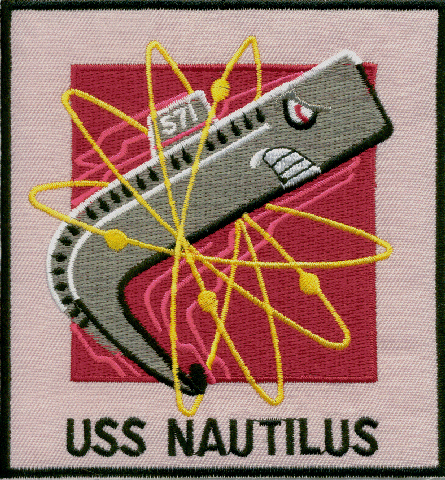
The USS Nautilus (above), the world’s first nuclear submarine,was commissioned by the U.S. Navy.
The Nautilus was constructed under the direction of U.S. Navy
Captain Hyman G. Rickover, a Russian-born engineer who
joined the U.S. atomic program in 1946. In 1947, he was put in
charge of the navy’s nuclear-propulsion program and began work
on an atomic submarine.
In 1952, the Nautilus‘ keel was laid by President Harry S. Truman,
and on January 21, 1954, first lady Mamie Eisenhower broke a
bottle of champagne across its bow as it was launched into the
Thames River at Groton, Connecticut.


On August 3, 1958, the U.S. nuclear submarine Nautilus
accomplished the first undersea voyage to the geographic
North Pole. The world’s first nuclear submarine, the Nautilus
dived at Point Barrow, Alaska, and traveled nearly 1,000 miles
under the Arctic ice cap to reach the top of the world.