


CARLATA BRADLEY



CARLATA BRADLEY

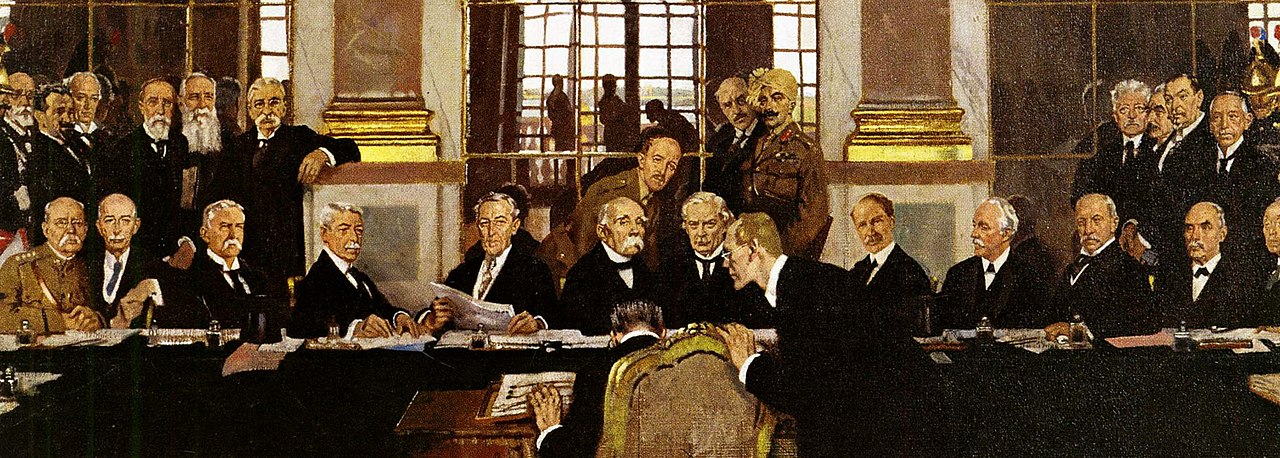
On January 18, 1919, in Paris, France, some of the most
powerful people in the world meet to begin the long,
complicated negotiations that would officially mark the
end of the First World War.

Dignitaries gathering in the Hall of Mirrors at the Palace of Versailles, France, to sign the Treaty of Versailles.

Official delegates photograph taken at the conference.

The Council of Four (Also known as the ‘Big Four’) at the
Paris Peace Conference. President Woodrow Wilson is
at the far right.

On January 14, 1784, the Continental Congress ratified the
Treaty of Paris, ending the War for Independence.
In the document, which was known as the Second Treaty
of Paris because the Treaty of Paris was also the name of
the agreement that had ended the Seven Years’ War in 1763,
Britain officially agreed to recognize the independence of its
13 former colonies as the new United States of America.


Article 10 of the Treaty of Paris. At the bottom are
the signatures of the American representatives
and their respective seals.

Artist Rob Brun
On December 16, 1944, the Germans launched the last major
offensive of the war, Operation Autumn Mist, also known as
the Ardennes Offensive and the Battle of the Bulge, an
attempt to push the Allied front line west from northern
France to northwestern Belgium.
The Battle of the Bulge, so-called because the Germans
created a “bulge” around the area of the Ardennes forest
in pushing through the American defensive line, was the
largest fought on the Western front.

American troops man trenches along a snowy hedgerow in
the northern Ardennes Forest during the Battle.

An American artilleryman shaves in frigid cold, using a
helmet for a shaving bowl.

An American tank moves past another gun carriage which
slid off an icy road in the Ardennes Forest during the
Battle of the Bulge.

Belgian residents of a northern Ardennes hamlet flee the fighting during the
Battle of the Bulge.


At the 11th hour on the 11th day of the 11th month of 1918, the
Great War ended. At 5 a.m. that morning, Germany, bereft of
manpower and supplies and faced with imminent invasion,
signed an armistice agreement with the Allies in a railroad car
outside Compiégne, France (above).
The First World War left nine million soldiers dead and 21
million wounded, with Germany, Russia, Austria-Hungary,
France and Great Britain each losing nearly a million or
more lives. In addition, at least five million civilians died
from disease, starvation or exposure.


