
On February 8, 1943, Japanese troops evacuate Guadalcanal,
leaving the island in Allied possession after a prolonged
campaign. The American victory paved the way for other
Allied wins in the Solomon Islands.


On February 8, 1943, Japanese troops evacuate Guadalcanal,
leaving the island in Allied possession after a prolonged
campaign. The American victory paved the way for other
Allied wins in the Solomon Islands.

On December 29, 1890, in one of the final chapters of America’s
long Indian wars, the U.S. Cavalry killed 146 Sioux at Wounded
Knee on the Pine Ridge reservation in South Dakota.


A depiction of the Ghost Dance.

Civilian burial party, loading victims on a cart for burial.

Mass grave at the site of the 1890 Wounded Knee Massacre.

On December 16, 1944, the Germans launch the last major
offensive of the war, Operation Autumn Mist, also known
as the Ardennes Offensive and the Battle of the Bulge, an
attempt to push the Allied front line west from northern
France to northwestern Belgium. The Battle of the Bulge,
so-called because the Germans created a “bulge” around
the area of the Ardennes forest in pushing through the
American defensive line, was the largest fought on the
Western front.


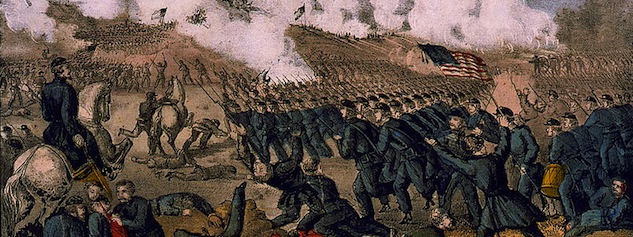
On December 13, 1862, Confederate General Robert E. Lee’s Army
of Northern Virginia repulsed a series of attacks by General
Ambrose Burnside’s Army of the Potomac at Fredericksburg,
Virginia.
The defeat was one of the most decisive loses for the Union army,
and it dealt a serious blow to Northern morale in the winter of 1862-
63.

General Ambrose Burnside General Robert E. Lee



The Naval Battle of Guadalcanal, a multi-day battle that would
see more than 1,700 Americans killed, began on this day in
history, Nov. 12, 1942.
Guadalcanal is the largest island in the Solomon Islands, a
country located in the Pacific Ocean northeast of Australia
and east of Papua New Guinea.


