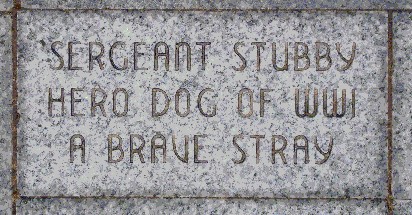
Sergeant Stubby, a bull terrier mutt, received a gold medal from America’s WWI commanding general John Pershing for “heroism of highest caliber” in 17 battles.
Among his heroic deeds: catching a German spy by biting his legs.
Stubby died in his sleep in March 1926. He was 8 or 9 years old.
Gen. John Pershing awards Sergeant Stubby with a medal from the Humane Education Society at a White House ceremony.
National Medal of Honor Day on March 25th recognizes all Medal of Honor recipients. On March 25, 1863, Secretary of War, Edwin Stanton presented the first Medals of Honor (Army) to six members of “Andrews Raiders” for their volunteering and participation during an American Civil War raid in April of 1862.
On May 3, 1783, General George Washington (above) awarded the Badge of Military Merit to two brave Connecticut soldiers at the Continental Army headquarters in Newburgh, New York.
On this day in 1782, in Newburgh, New York, General George Washington, the commander in chief of the Continental Army, creates the “Badge for Military Merit,” a decoration consisting of a purple, heart-shaped piece of silk, edged with a narrow binding of silver, with the word Merit stitched across the face in silver (above).
The badge was to be presented to soldiers for “any singularly meritorious action” and permitted its wearer to pass guards and sentinels without challenge. The honoree’s name and regiment were also to be inscribed in a “Book of Merit.”
Washington’s “Purple Heart” was awarded to only three known soldiers during the Revolutionary War: Elijah Churchill, William Brown and Daniel Bissell, Jr. The “Book of Merit” was lost, and the decoration was largely forgotten until 1927, when General Charles P. Summerall, the U.S. Army chief of staff, sent an unsuccessful draft bill to Congress to “revive the Badge of Military Merit.”
In 1931, Summerall’s successor, General Douglas MacArthur, took up the cause, hoping to reinstate the medal in time for the bicentennial of George Washington’s birth. On February 22, 1932, Washington’s 200th birthday, the U.S. War Department announced the creation of the “Order of the Purple Heart” (below).
On this day in 1957, nine black students attempt to attend Central High School in Little Rock, Arkansas. The situation turnedpotentially violentand President Eisenhower sent in the national Guard to escort the students to school.
The Ford Motor Company began selling the Edsel on this day in 1957. The car was so unpopular that it was taken off the market only two years.
Los Angeles, CA, was founded by Spanish settlers on this day in 1781. The original name was "El Pueblo de Nuestra Senora La Reina de Los Angeles de Porciuncula," which translates as "The Town of the Queen of Angels."
Statue depicting Governor Felipe de Neve, in Los Angeles Plaza.
On this day in 1888, George Eastman registered the name "Kodak" and patented his roll-film camera (below). The camera took 100 exposures per roll.
The original Kodak camera, introduced by George Eastman.
George Eastman(July 12, 1854 – March 14, 1932)
On this day in 1972, swimmer Mark Spitz captured his seventh Olympic gold medal in the 400-meter medley relay event at Munich, Germany. Spitz was the first Olympian to win seven gold medals.
Mark Andrew Spitz turned 67 on February 10.
Beyoncé Giselle Knowles-Carter is 36 today.
Beyoncé is a former member of the R&B girl group Destiny’s Child who also became a widely successful solo artist. She has won a total of 22 Grammy Awards for songs such as "Single Ladies," "Drunk in Love" and "Crazy in Love." She won her first school talent show with her rendition of "Imagine" by John Lennon.


![[chicagogram] Let us never forget the men and women who lost their lives or those who put their lives on the line to help others 11 years ago today. #911 #neverforget #america #americanflag #american #flag](https://i0.wp.com/media.nbcdfw.com/2019/09/8e70faecfc1611e1bb6a1231381f737d7.jpg?resize=520%2C406&ssl=1)