

DAVID MELENDY


On this day in 1970, Apollo 13 returned to Earth safely after an on-
board accident with an oxygen tank.
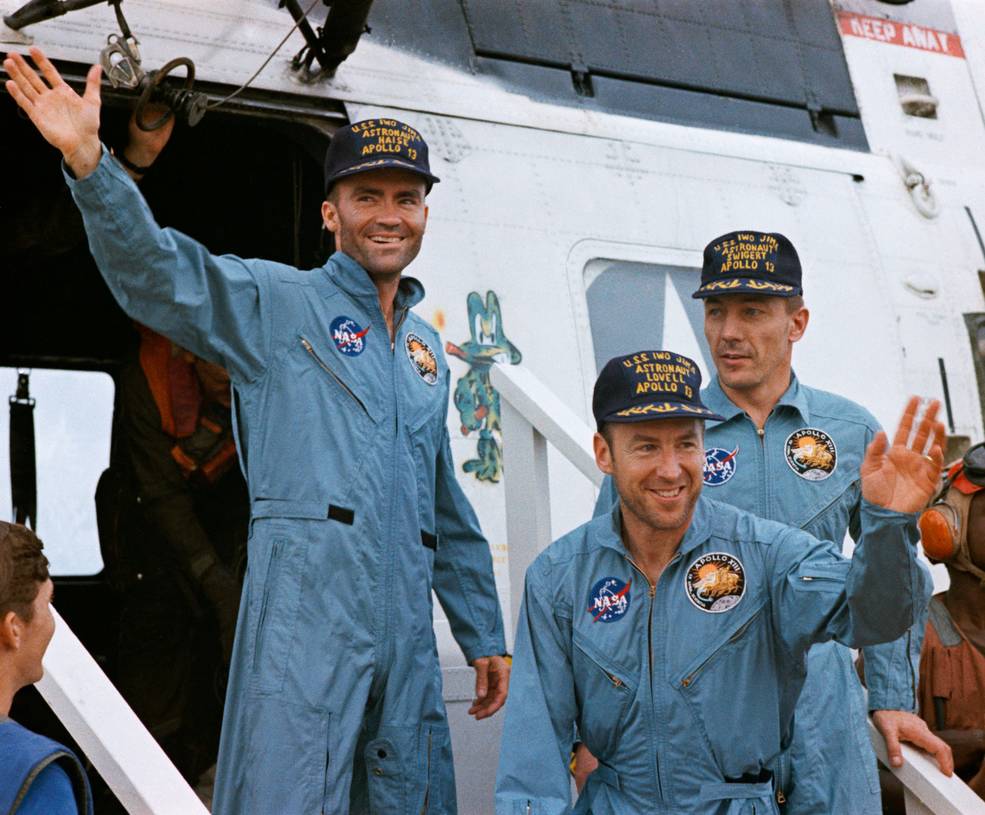
The Apollo 13 crew following recovery.

DAVID MELENDY
On this day in 1970, Apollo 13 returned to Earth safely after an on-
board accident with an oxygen tank.
The Apollo 13 crew following recovery.


TIM MAGUIRE


On this day in 1970, Apollo 13 blasted off on a mission to the moon
that was disrupted when an explosion crippled the spacecraft. The
three astronauts onboard consisted of James A. Lovell, Jr., John L. Swigert, Jr., and Fred W. Haise, Jr. All three managed to return
safely to Earth on April 17, six days after launch.

The crew of the Apollo 13 mission step aboard the U.S.S. Iwo Jima,
prime recovery ship for the mission, following splashdown and
recovery operations in the South Pacific. From left: astronauts Fred.
W. Haise, Jr., lunar module pilot; James A. Lovell Jr., commander;
and John L. Swigert Jr., command module pilot.


SANDY KOZEL

NASA announced the selection of America’s first seven astronauts
on this day in 1959.

John Glenn boards the Friendship 7 capsule to become the first American to orbit Earth.


MIKE GRACIA

Henry Kissinger (seated center) signs the Paris Peace Accords on
this day in 1973 in Paris. The war ended on April 30, 1975, when
Saigon surrendered almost without fighting to the communist
forces, ending the United States’ involvement in Vietnam.

Nguyen Duy Trinh (center) heads the delegation from the Democratic Republic of Vietnam.


At Cape Kennedy, FL, on this day in 1967, astronauts Virgil I.
"Gus" Grissom, Edward H. White and Roger B. Chaffee died
in a flash fire during a test aboard their Apollo I spacecraft.


The charred remains of the Apollo 1 cabin interior.


SANDY KOZEL


Apollo 8 astronauts, James A. Lovell, William Anders and Frank
Borman, reached the moon on this day in 1968. They orbited the
moon 10 times before coming back to Earth. Seven months later
man first landed on the moon.


Apollo 8 crew members (from left) James A. Lovell Jr., William A.
Anders and Frank Borman.


