The American flag was flown in battle for the first time, during a Revolutionary War skirmish at Cooch’s Bridge, Delaware. Patriot General William Maxwell ordered the stars and strips banner raised as a detachment of his infantry and cavalry met an advance guard of British and Hessian troops. The rebels were defeated and forced to retreat to General George Washington’s main force near Brandywine Creek in Pennsylvania.
The first major battle of the U.S. Civil War began. It was the Battle of Bull Run at Manassas Junction, VA. The Confederates won the battle. Union forces endured a loss of 3,000 men killed, wounded, or missing in action while the Confederates suffered 2,000 casualties.
Kenneth R. “Kenny” Shadrick (August 4, 1931 – July 5, 1950)
Near Sojong, South Korea on this day in 1950, Private Kenneth Shadrick, a 19-year-old infantryman from Skin Fork, West Virginia, becomes the first Americanreported killed in the Korean War. Shadrick, a member of a bazooka squad, had just fired the weapon at a Soviet-made tank when he looked up to check his aim and was cut down by enemy machine-gun fire.
A U.S. soldier with a 2.36-inch bazooka prepares to take aim at a North Korean tank during the Battle of Pyongtaek. On the right is Private Shadrick.
This picture was mailed home to Shcarick’s parents signed, the hard labor kid.
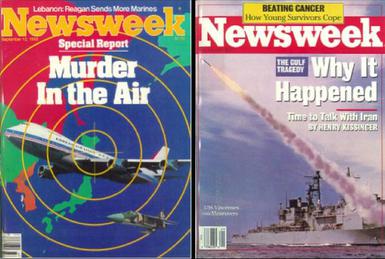
In the Persian Gulf on this day in 1988, the U.S. Navy cruiser Vincennes shoots down an Iranian passenger jet that it mistakes for a hostile Iranian fighter aircraft. Two missiles were fired from the American warship–the aircraft was hit, and all 290 people aboard were killed. The attack came near the end of the Iran-Iraq War, when U.S. vessels were in the gulf defending Kuwaiti oil tankers. Minutes before Iran Air Flight 655 was shot down, the Vincennes had engaged Iranian gunboats that shot at its helicopter.
Iran called the downing of the aircraft a “barbaric massacre,” but U.S. officials defended the action, claiming that the aircraft was outside the commercial jet flight corridor, flying at only 7,800 feet, and was on a descent toward the Vincennes. However, one month later, the United States acknowledged that the airbus was in the commercial flight corridor, flying at 12,000 feet, and not descending. The U.S. Navy report blamed crew error caused by psychological stress on men who were in combat for the first time. In 1996, the U.S. agreed to pay $62 million in damages to the families of the Iranians killed in the attack.